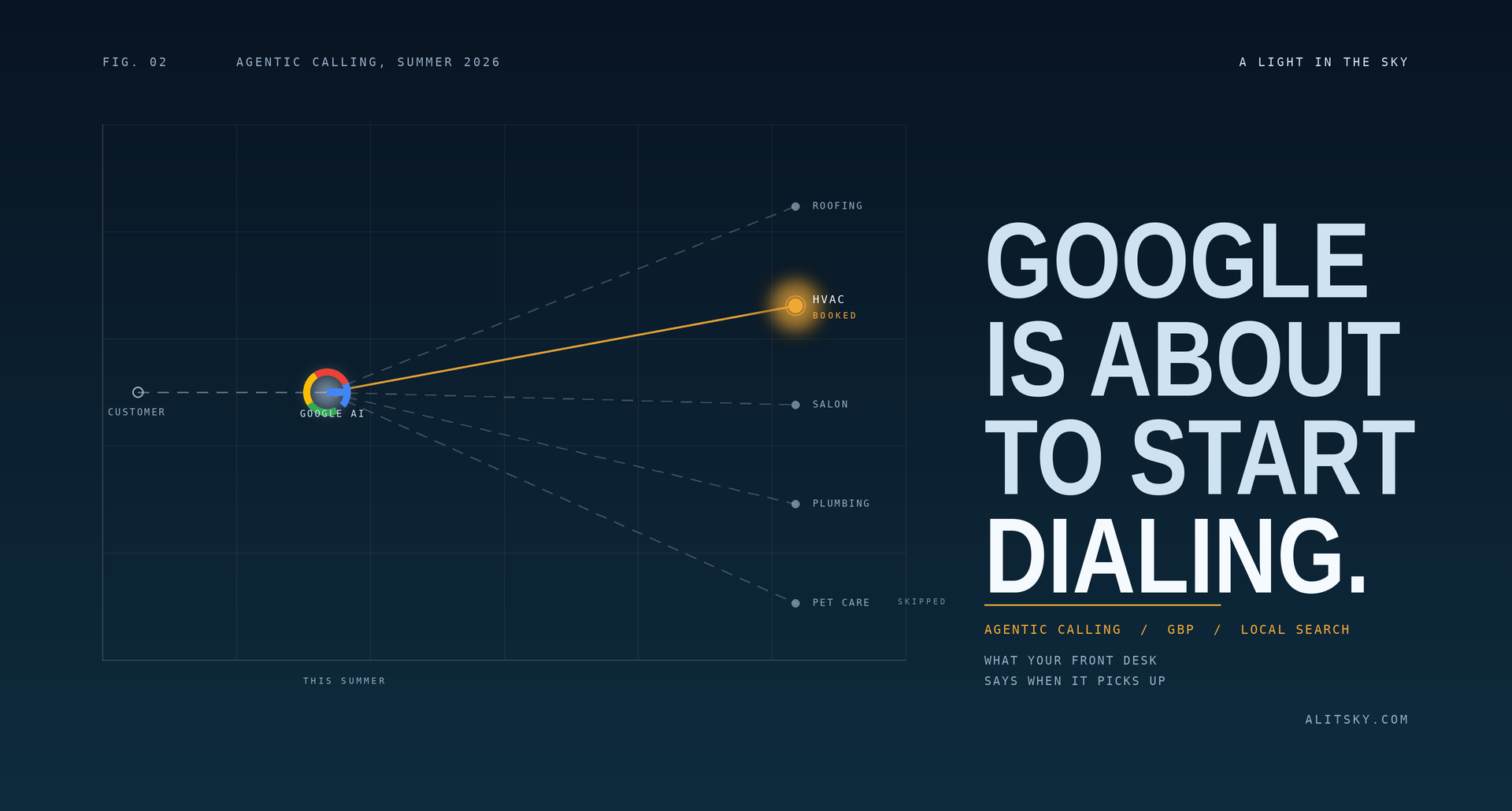
For twenty years the local customer did the calling. A pipe bursts, they pull up three plumbers, they dial. That step is about to move from the customer to a machine, and most owners have no idea it is coming.
What Google actually announced
At its I/O event on May 19, 2026, Google said that in AI Mode you can now ask it to book local services for you. You give your criteria, and Search pulls together current pricing and availability with direct links to finish the booking through the provider you choose.
Then the line that matters for anyone who answers a phone for a living. In Google's own words:
"For select categories like home repair, beauty or pet care, you can ask Google to call businesses on your behalf. These capabilities will roll out to everyone in the U.S. this summer."
Read that again. Home repair covers HVAC, plumbing, electrical, and roofing. Beauty covers salons, spas, and lash and nail studios. Pet care covers groomers and boarding. For those categories, the customer describes the job, and Google's AI places the phone call, asks your front desk for a time and a price, and brings the answer back to the person who never dialed you directly.
This is not a rumor or a leak. It is on Google's official Search blog, dated, attributed to Liz Reid, the VP who runs Search. The same post says AI Mode has passed one billion monthly users, with queries more than doubling every quarter since launch.
What "this summer" means
It is July 8 as we write this. "This summer" is now. The feature started for U.S. users enrolled in Search Labs, so it is not yet on every phone in the country. But the rollout window Google named is the one we are sitting in. This is not a next-year problem to schedule around. It is a this-quarter change to your inbound calls.
What this does to your front desk
Think about how a booking gets won today. A person calls, a person answers, they talk, they book. Now picture the caller is an AI working for a customer who set it loose and walked away. It wants a clear answer. Price for the job, next available slot, whether you cover the area. If your phone rings out to voicemail, the customer's agent does not leave a heartfelt message. It moves to the next business on the list and asks them the same thing.
Google has not published a stopwatch or a rulebook for how patient that agent is. Some analysts writing about this expect it to move fast and favor whoever gives a clean, structured answer quickly, but that is their read, not Google's stated spec, so treat it as an educated guess. What is not a guess is the direction. The businesses that answer, answer clearly, and have accurate hours and a working booking link are the ones that get quoted. The ones that miss the call, or make the agent work to get a straight price, get skipped without ever knowing a customer was there.
The honest catch
This cuts two ways, and it is worth being straight about both.
On one hand, an AI that calls around for a nervous homeowner and hands them two or three real quotes is genuinely useful, and it can put a small shop in front of a customer it would never have reached. On the other, it strips the human moment out of the first contact. The warmth in your receptionist's voice, the rapport that closes a job, none of that lands on a machine that only wants a number and a date. You are being graded by a caller that cannot be charmed.
There is also a real question Google has not fully answered yet about how businesses will know a call came from its agent versus a human, and whether you can opt out of being called this way. Those details are thin right now. That uncertainty is itself a reason to pay attention rather than assume it will sort itself out.
What to actually do about it
You do not need new software for this. You need the basics to be true and current.
Your Google Business Profile has to be right. Real hours, correct service area, the categories that match what you do, a phone number that reaches a human during business hours, and a booking link that actually works. If your listed hours are stale or your booking URL is dead, the agent has nothing clean to work with, and it will find a competitor whose information is in order.
Whoever answers your phone needs to be able to give a straight answer to a straight question. Not a full quote on every job, some need a visit, but at minimum a real range, a real next-available window, and a clear yes or no on the service area. The clearer and faster that answer, the better your odds when the caller is a machine comparing you against the shop down the road.
And your website has to back all of it up, because the same customer who lets an AI call around will also ask an AI which of those businesses to trust. That is the visibility layer underneath the phone call: structured information, consistent facts, real reviews, and pages a machine can read and cite. The phone call decides the booking. What the AI already believes about you decides whether you were on the list to be called at all.
The takeaway
The last time the front door to local business moved was mobile, when the search bar went in everyone's pocket. This is the next move, and it is bigger, because now the customer does not even have to make the call. Their AI does.
The shops that treat this as a five-minute check on their listing and a quick talk with whoever answers the phone will quietly start winning bookings they never knew were up for grabs. The ones who wait to see how it plays out will lose calls they never hear ring.
Google is about to start dialing. The only question is whose number it has, and what your front desk says when it picks up.
Sources
- Google Search blog, "A new era for AI Search" (Elizabeth Reid, May 19, 2026)
- Google Shopping blog, agentic calling ("let Google call")
- Google, "Explore new ways to plan and book travel with AI in Search" (agentic booking background)
- Local Falcon, "Google Adding Search Agents, Expanding Agentic Booking Capabilities in Local Search"
- MarketingCode analysis of the home-repair impact (third-party interpretation, labeled as such above)

A Light in the Sky builds websites and AI visibility that turn searches into booked calls, by fixing where leads leak before the phone rings. Want to know whether your listing and site are ready for the day Google's AI calls on a customer's behalf? We will send a quick lead-leak teardown of the exact spots we notice. No cost, no obligation.