A new study of the heating and cooling business landed this week, and it draws the clearest picture yet of where a local service customer actually meets AI, and where they still do not.
The short version: AI has taken over the research. It has barely touched the hiring. If you run a service business, that split is the whole game right now.
What the study found
A marketing agency called HVAC SEO analyzed 512 US heating and cooling search terms in July 2026, using Semrush to detect which searches show a Google AI Overview, the AI-written answer Google places above every website, ad, and map listing. The terms cover about 4.9 million searches a month.
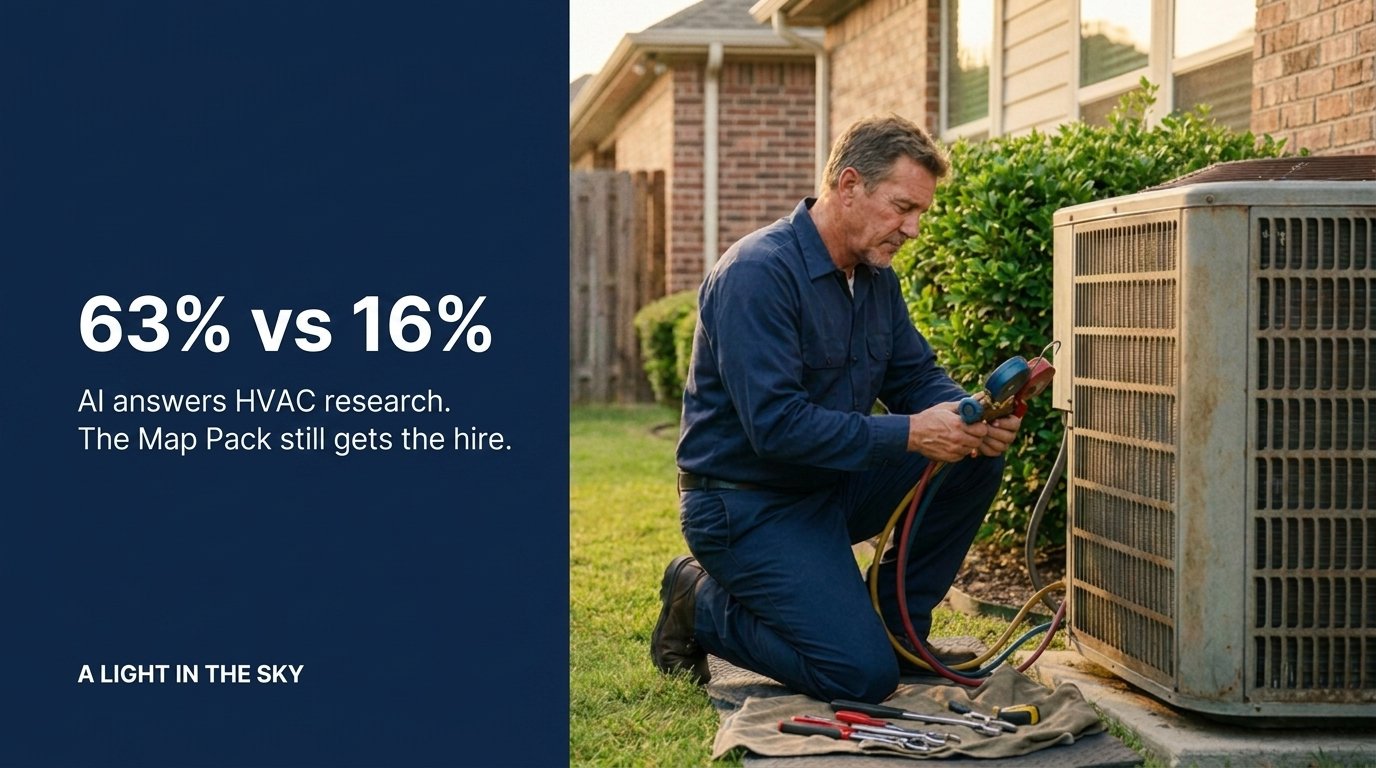
Two in three of those searches, 63 percent, now show an AI Overview. That is the headline. But the more useful finding is where the AI shows up and where it stays away.
Every one of the 30 most common question searches triggered an AI answer. "How much does a new HVAC system cost." "How long do HVAC systems last." "Heat pump vs furnace." For those, the AI response now sits on top of the page, and the homeowner gets what they came for without visiting a single website. Research-stage searches overall showed AI Overviews 61 percent of the time.
Now the other half. Local-intent searches, the "furnace repair near me" and "furnace repair" plus a city name that people type when they are ready to hire, showed an AI Overview only 16 percent of the time. Those searches still lead with Google's Map Pack, the block of three local businesses at the top of the map. Industry data from BrightLocal, cited in the study, puts the Map Pack at a third or more of all clicks on those searches.
One more finding worth sitting with. When the study ran a typical buyer search across Google and nine AI platforms including ChatGPT, Perplexity, and Gemini, more than half the businesses the AI assistants named did not show up in Google's results for the same search. The two systems only agreed at the very top. Below that, they reward different things and recommend different companies.
The honest catch on this study
HVAC SEO is an agency that sells the exact service this study makes a case for. That is worth saying plainly. The method is reasonable, Semrush SERP detection across a real keyword set, and the numbers line up with what independent outlets have reported. Forbes wrote in May 2026 that AI Overviews appear on about 58 percent of Google searches and cut click-through rates by as much as 89 percent. So treat the specific 63 percent as one agency's July snapshot of one industry, not gospel, but the direction is confirmed by sources with no dog in the fight.
The other honest note: this is HVAC data. The exact percentages will differ for a roofer, a med spa, a plumber, or a law office. What almost certainly holds across all of them is the shape of it. Informational questions get answered by AI. "Near me" hiring searches still run through the map.
What this means for your business
For years the advice was "rank on Google." That advice is now incomplete, because there is no single "Google" anymore. There is the AI answer that handles the research, and there is the Map Pack that handles the hire, and they are two different contests with two different rulebooks.
If a homeowner asks their AI "is my 15-year-old furnace worth repairing" and your business is nowhere in that answer, you missed the moment they started thinking about the problem. If they then type "furnace repair Denver" and you are not in the top three of the map, you missed the moment they went to buy. A business absent from both is invisible at both ends of the same customer's journey, and never knows it.
The work splits the same way. Being named in AI answers comes from structured content, clear facts, real expertise a machine can read and cite, the GEO and AEO layer. Winning the Map Pack comes from an accurate Google Business Profile, real reviews, consistent business information, and local signals. Neither one covers for the other. The businesses that treat them as one connected system, front of the journey and back of it, are the ones showing up when it counts.
The takeaway
The useful thing about this study is not the scary 63 percent. It is the 16 percent. It tells you the hiring moment is still winnable in the place it has always lived, the local map, while the research moment has quietly moved into AI. You do not have to pick one. You have to be findable in both, because your customer now uses both, often in the same afternoon, without thinking about it as two different things at all.
Most of your competitors are still optimizing for a version of search that describes about half of what their customers actually do. That gap is the opening.
Sources
- HVAC SEO study, "Two in Three HVAC Searches Now Show Google AI Answers" (EIN Presswire, July 8, 2026)
- HVAC SEO, full report and methodology, "AI Overview visibility for HVAC contractors"
- Forbes, "Google AI Overviews Are Eating Your Website Traffic. Here's How To Get That Traffic Back" (Terdawn DeBoe, May 18, 2026)
- Search Engine Journal, "Multi-Location SEO: How To Win Google & AI Search Visibility At Scale" (July 2026)

A Light in the Sky builds websites and AI visibility that turn searches into customers. Want to see whether AI names your business in the research stage and whether you show up in the map when someone is ready to hire?