For twenty years, finding a business meant one thing: type it into Google, scan ten blue links, click one.
That behavior is breaking apart right now, and the numbers are hard to ignore.
What the data says
ChatGPT crossed 1 billion monthly active users in 2026, the fastest app in history to hit that mark. It now handles roughly 17 percent of all digital queries worldwide, the first double-digit dent in Google's share in two decades. Filtered for search-style questions alone, ChatGPT already carries about 12 percent of Google's search volume, which means it quietly passed Bing to become the second largest search platform on earth.
And it is not just ChatGPT. Gemini more than doubled its share in a year and reached 750 million monthly users. Claude and Perplexity are growing triple digits. In the US, AI platforms now account for roughly a third of search-equivalent traffic.
Here is the number that should stop every business owner: Google's share of combined information discovery, search plus AI together, fell from 89.3 percent in December 2022 to 57.6 percent in December 2025. That is not a forecast. It already happened.
The part most people miss
Total search did not shrink. It grew 26 percent. People are asking more questions than ever. They are just asking them in new places, and the answers they get back look nothing like ten blue links.
When someone asks ChatGPT "who is the best HVAC company near me" or "which med spa in Denver has the best reviews for microneedling," the AI gives them two or three names. Not a page of options. Two or three.
If your business is not one of those names, you do not lose the click. You lose the entire conversation. The customer never knows you exist.
Why this matters more for service businesses
Service businesses live and die on discovery. Nobody has a favorite plumber bookmarked before their pipe bursts. The moment of need is the moment of search, and that moment is migrating to AI at scale, especially with younger customers, where usage rates already pass 70 percent.
Two more numbers make the case:
AI visitors convert far better. Traffic referred from AI platforms converts at roughly 14 percent versus about 3 percent from traditional organic search, a four to five times lift confirmed across multiple independent studies. These are not casual browsers. They arrived because a machine they trust told them you are the answer.
Even Google is not Google anymore. About half of Google searches already show AI-generated summaries, projected to reach 75 percent by 2028. A first-place ranking that once earned 20 to 30 percent of clicks now earns 8 to 12. The blue links are still there. Fewer people are clicking them.
What this means for your website
Most websites were built for a reader with eyes. AI reads differently. It looks for structured data, clear answers, verifiable facts, consistent business information, real reviews, and pages a machine can parse in milliseconds. Sites missing those signals are effectively invisible to the fastest-growing discovery channel in the world.
This is where three disciplines now work together:
SEO still matters. Google still sends the most raw traffic, and the fundamentals of a fast, well-structured, authoritative site are the foundation everything else stands on.
AEO (answer engine optimization) shapes your content so AI summaries and answer boxes can lift your business as the direct answer to a question, not just a link below one.
GEO (generative engine optimization) makes your business citable. Structured data, entity clarity, consistent facts across the web, and content written so that ChatGPT, Gemini, Claude, and Perplexity can confidently recommend you by name.
The businesses treating these as one system are already being named in AI answers while their competitors wait on page two of a results page fewer people scroll.
The trajectory from here
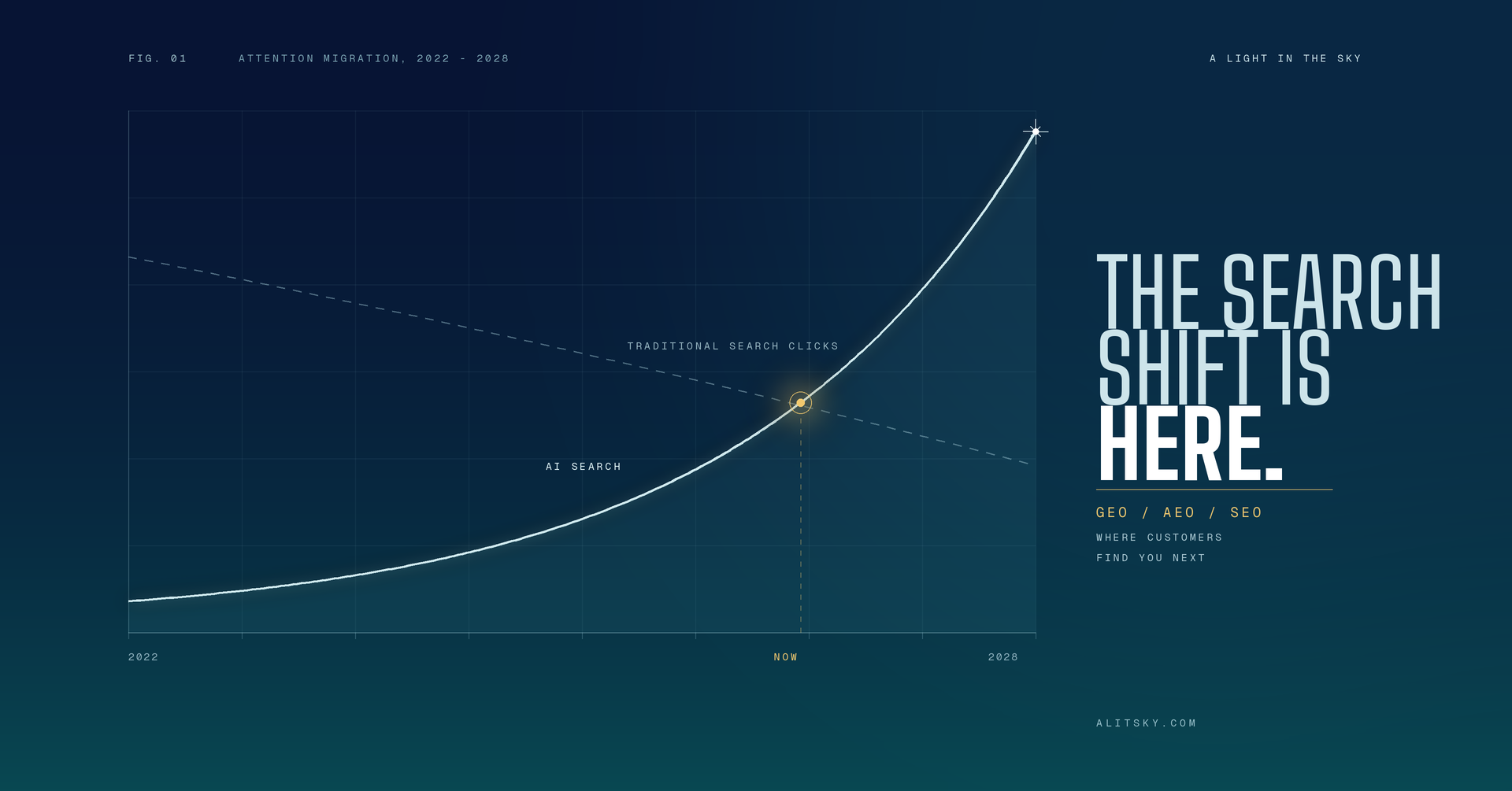
Gartner projected traditional search traffic to websites would fall 25 percent by 2026, and that call is tracking close to reality. Semrush projects AI search could pass traditional organic search as a traffic source for many sites around 2028. McKinsey puts the at-risk share of traditional search traffic between 20 and 50 percent by the same year.
Nobody knows the exact date the lines cross for your industry. What the data makes clear is the direction: discovery is moving from ranked links to generated answers, and the window to establish your business inside those answers is open now, while most of your competitors have not started.
The last shift like this was mobile. The businesses that adapted early owned their markets for a decade. The ones that waited spent years catching up.
Search is having its mobile moment. The question is which side of it your business will be on.

A Light in the Sky builds websites and AI visibility that turn searches into customers. See what an AI engine says about your business right now, then ask us what it should be saying.